Effect · Filter
Orbiton
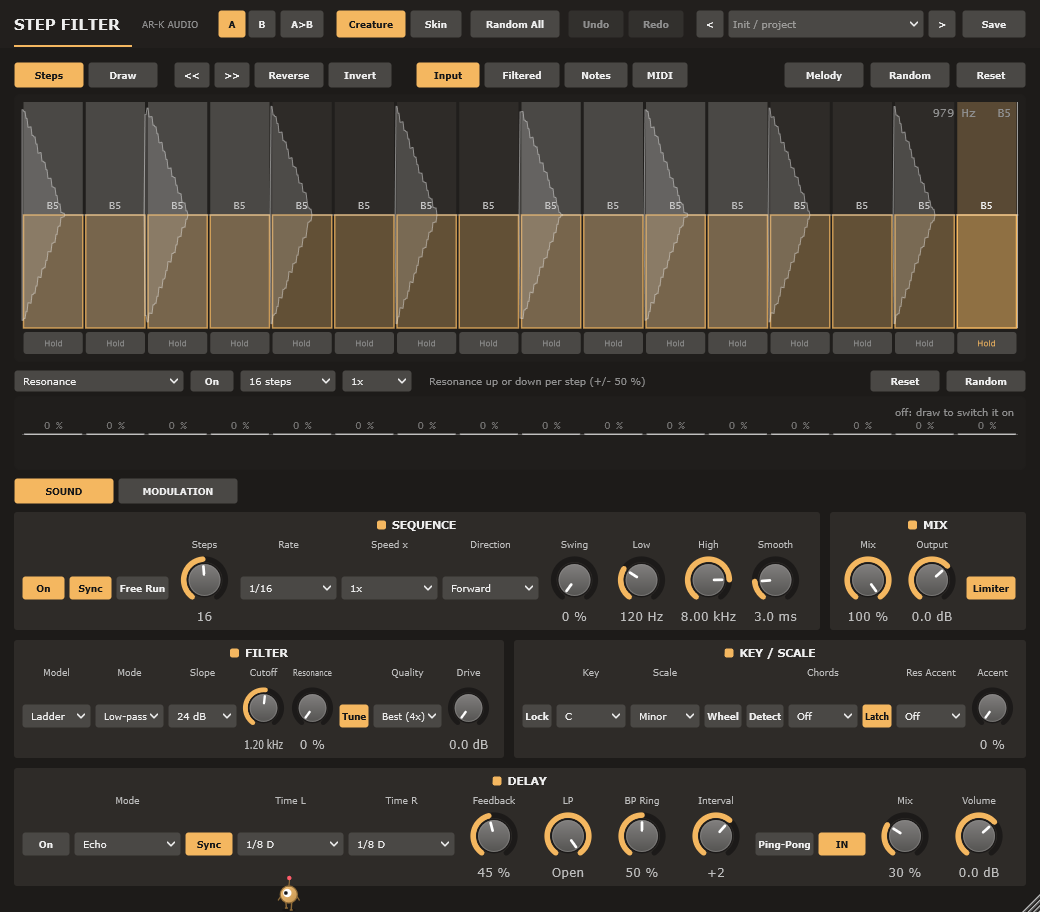
A step filter where every frequency is a note of your key. Draw steps, pick one of 52 filter models, and the filter plays a melody.
In developmentOrbiton
AR-K AUDIO makes VST3 plugins for Windows, made in and for Ableton Live. They share one core, one look and one musical language, and a small one-eyed alien called Orbit lives in every window.
Press play, then turn a knob. Someone down there likes it.
Each plugin does one thing in its own colour. Put them in one Live set and they listen to each other.
A step filter where every frequency is a note of your key. Draw steps, pick one of 52 filter models, and the filter plays a melody.
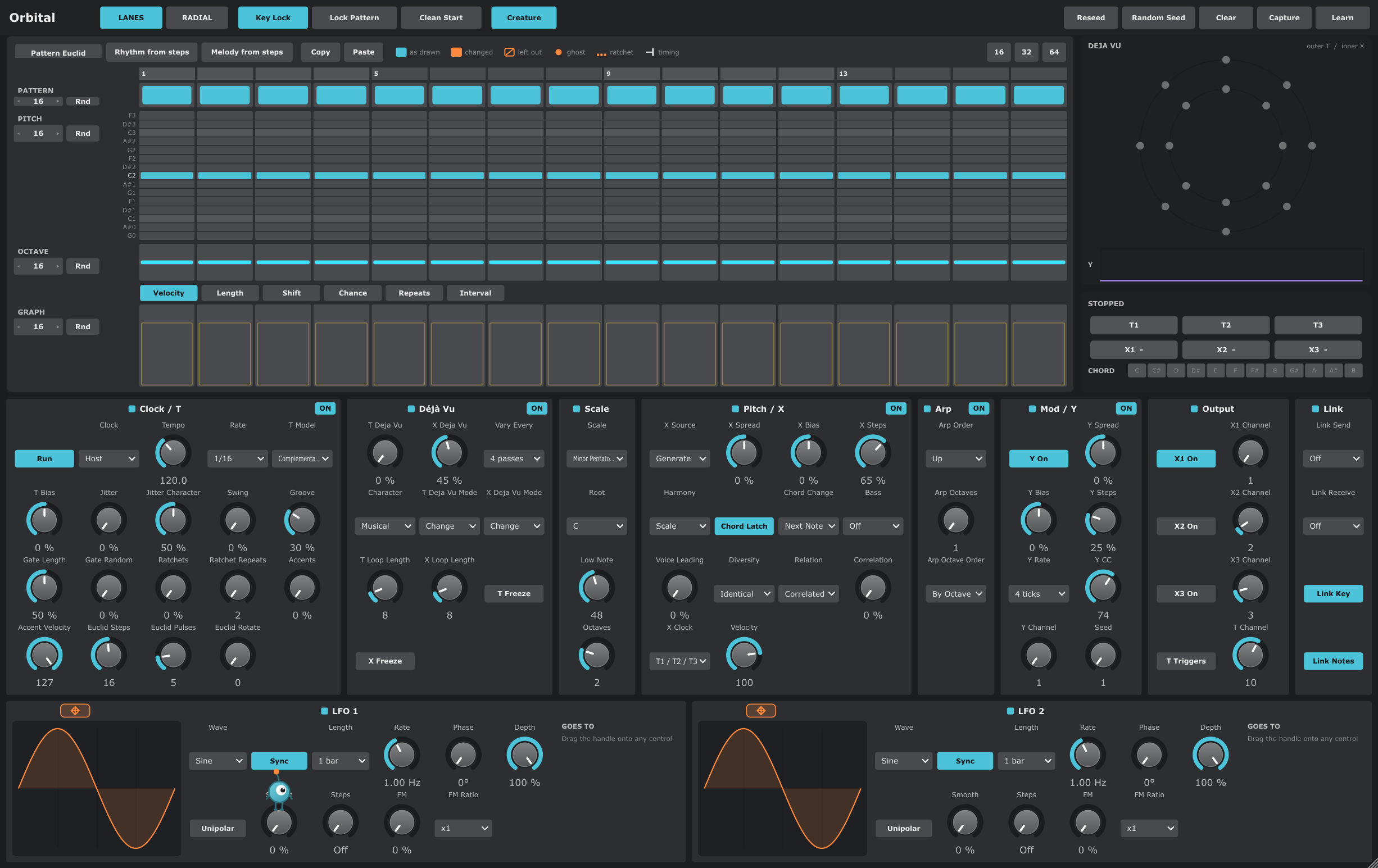
Random melodies and rhythms you can steer, with a Déjà Vu memory that repeats, slowly changes or reshuffles what it played. Always in key.
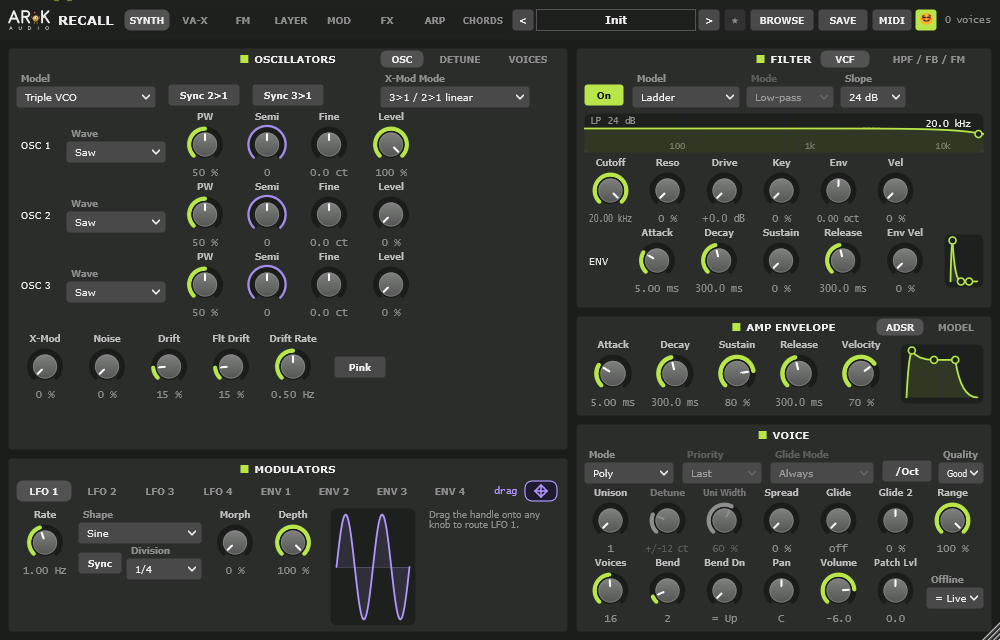
A polyphonic synth with chords, an arpeggiator and a step sequencer built in. Play one key and hear a whole progression, in key.
Catch a loop and get variations back: musical, or completely crazy. Grains from your loop, in key, played by the rest of the family.
AR-K plugins in one Live set share their key, their notes and their rhythm. No MIDI routing, no extra tracks: set the same Link channel on both sides and that's it.
Channels 1 to 4. The plugins find each other inside Live on their own.
Every AR-K plugin is built on ark-core, our own shared platform. That's why they connect without any setup, and why every new plugin you add fits right in with the ones you already have.
 ark-core
Buy one plugin and it already talks to the next one you get. No routing, no learning a new interface.
Improvements to the core reach every plugin: a better scale engine or a new Link message helps the whole family.
Every plugin is tested on the core: tuning, stability at every sample rate and buffer size, saved projects that open again exactly.
That's Orbit. He lives in every AR-K plugin window, he's the hyphen in our logo, and he takes on the colours of whichever plugin he's in.
He strolls along the panels, climbs your knobs and rides them when you turn them. Turn too fast and he goes "oh noo". When the music gets funky he dances. Leave him alone long enough and he falls asleep. And if he gets in the way, there's a button that sends him home.
A very long way, for a good bassline.
Very, very far away lies Hush, where nothing makes a sound. Not the wind, not the rivers, not even the fridges. Hushlings have one big eye (two would be showing off) and talk by blinking. One of them hummed all day. The neighbours thought his face was vibrating.
One night the red ball on his antenna started to glow. A sound was coming in from very far away: dum… dum-dum… DUM. A bassline, from a bedroom on Earth where someone was making music in Live with the speakers way too loud.
He built a spaceship from a saucepan, two paperclips and a lot of hope, and steered by the beat. He came in too fast ("oh noooo!"), bounced off a coffee mug and shot straight into the laptop's headphone jack.
Behind a door marked VST3: knobs, hundreds of them, and music everywhere. Every note in key, so he could sing as loud as he liked and never sound wrong. Being polite, he blended in: orange here, cyan there, lime next door.
He climbed a knob, the music started, and it turned round and round, just like the little moon he used to ride back home. His real name takes nine minutes to blink, so the producer called him what he was doing: Orbit.
He saw a gap between AR and K, thought it was a stage, and jumped in, arms up. He's been holding the company together ever since. Every week he beams a tiny MIDI file home. Last month, for the first time ever, Hush hummed back.
VST3 for Windows. Every AR-K plugin is built and tested in Ableton Live first.
Pick a key and a scale once. Filters, melodies and modulation stay on its notes.
One shared core, one look, one Orbit. Learn one plugin and you know your way around the next.
A step filter that plays in key. The cutoff follows a sequence you draw, and every frequency it makes is a note of your key and scale: the steps, the LFOs, the resonance peak, even the delay. So the filter plays melodies.
Choose one of 12 keys and 16 scales. Steps snap to the notes of the scale, and the resonance peak itself sits exactly on the note, in every filter model. Everything that moves the pitch goes through the same lock: LFOs, lanes, the envelope, the delay.
The four originals (Ladder, Multimode, SVF and a tuned Comb) and 48 circuit models in families: transistor and diode ladders, OTA, Curtis and SSM 4-poles, state-variable, Sallen-Key, ARP, Yamaha, modern analog and some 2-pole oddballs.
The names are playful nods to the instruments that inspired them; they are not those instruments.
Three ways to keep the echoes in key: Echo rings the repeats on the playing note, Scale Echo climbs the scale with every repeat, and Pitched tunes a tiny delay so the delay itself sings the melody. A lane decides per step what echoes, for dub throws.
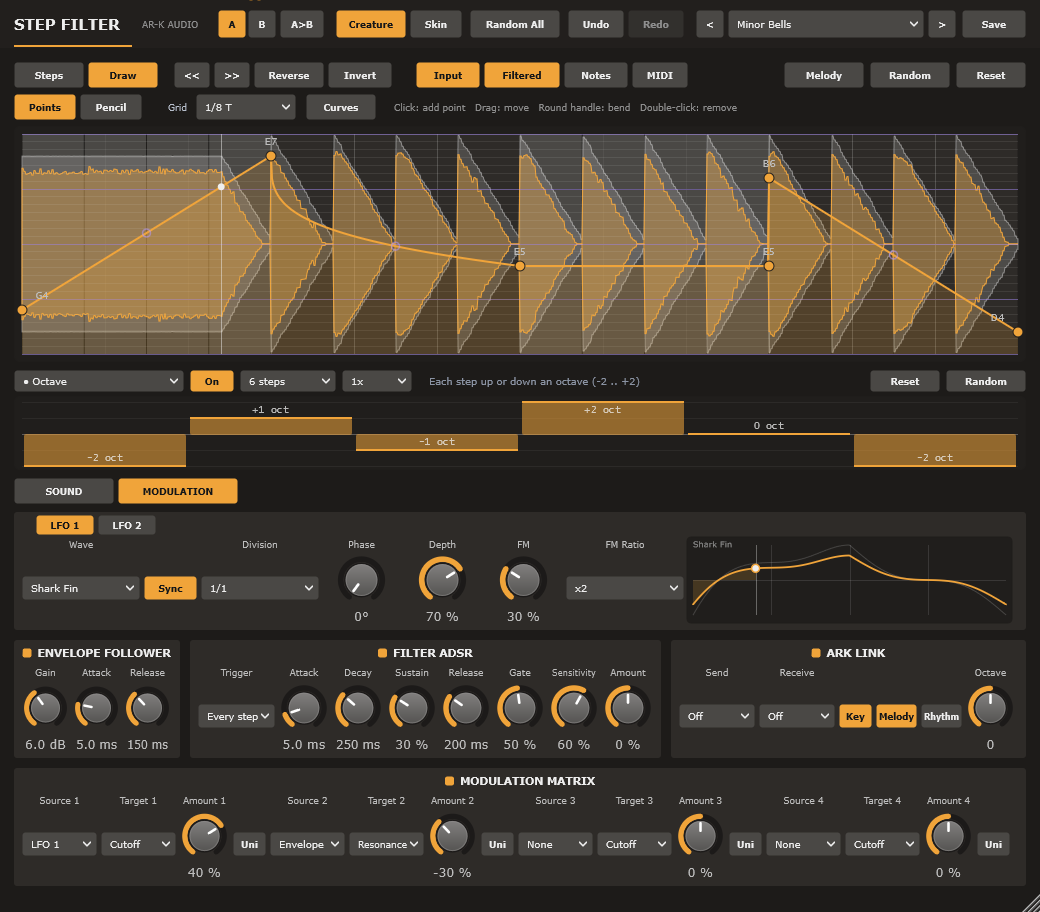
Through ARK Link, Orbiton can take the key and scale from another AR-K plugin, sing its melody with the filter instead of the steps, or start its envelope on the other plugin's beats. No routing in Live: just the same Link channel on both.
How ARK Link worksNot on sale yet. The price and the download will be in the shop.
Random melodies and rhythms you can steer. A Déjà Vu memory makes them repeat, slowly change or reshuffle, so random turns into a riff you can keep. Always in key.
Three rhythm streams (T) and three melody streams (X), plus a slow modulation (Y). T has seven ways to make a rhythm: coin flips, drums, Markov chains, clusters, dividers, Euclid, or your own steps. Add swing, jitter, ratchets and accents.
At 0 the loop repeats exactly. Turn it up and notes start to change, a few at a time, or the loop reshuffles its own notes. Rhythm and melody each have their own Déjà Vu, so you can keep the groove and let the melody wander. Freeze a part to keep it, even when you reopen the project.
Every control starts at "nothing happens". Turn things up gently and hear exactly what each one does.
Orbital is inspired by the ideas of the Marbles module and adapts parts of its open-source (MIT) firmware by Emilie Gillet. It doesn't claim to behave exactly like the hardware: it's made for a DAW, with Live's clock, scales and chords.
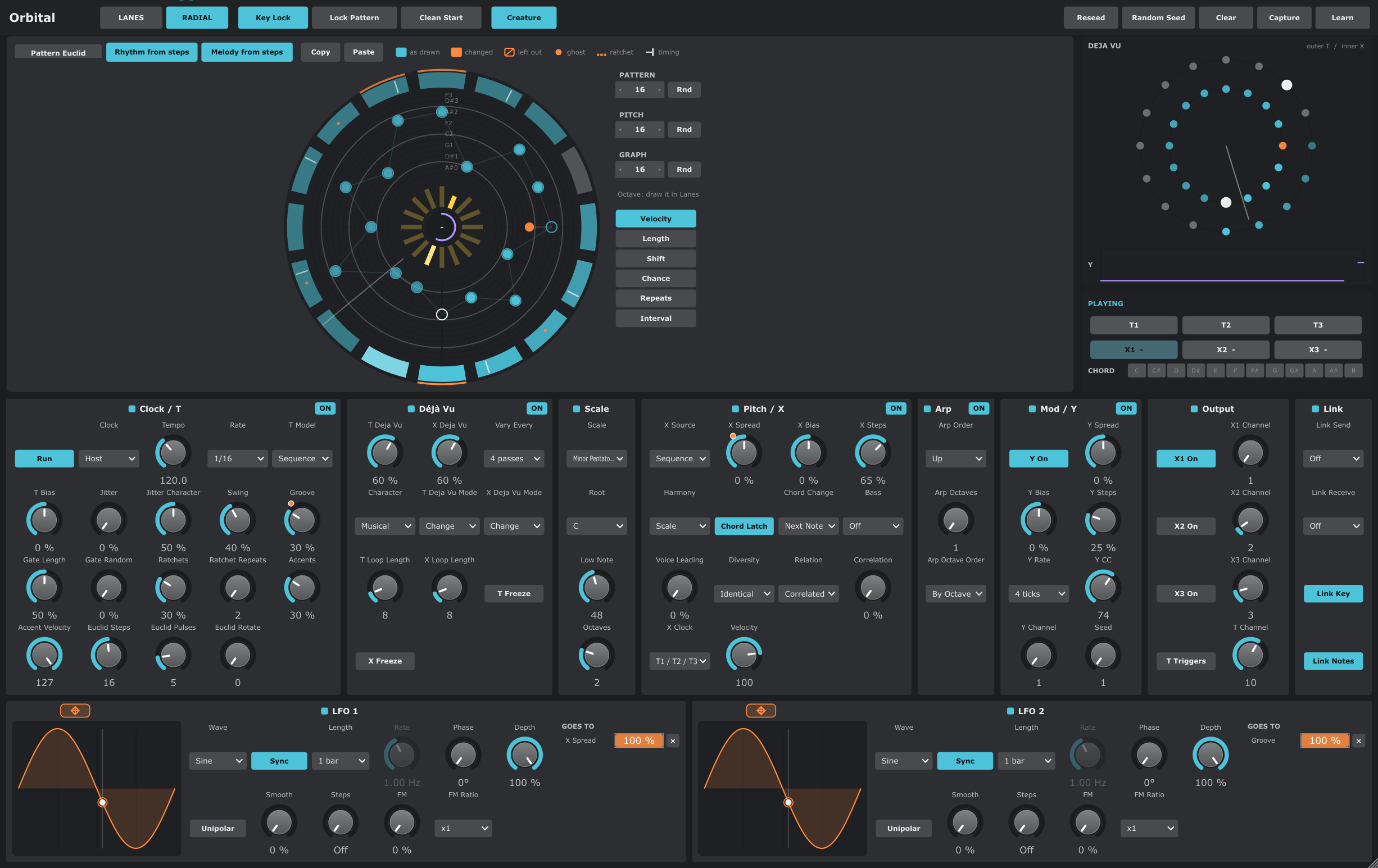
Through ARK Link, Orbital sends its melody, its rhythm, its modulation and its key to the other AR-K plugins. Orbiton can sing Orbital's melody; another Orbital can arpeggiate it. Orbital listens too: notes from another plugin come in as if you were holding them.
In Live, Orbital loads as an instrument on its own MIDI track (Live has no slot for third-party MIDI effects). Synth tracks play it with MIDI From: Orbital.
How ARK Link worksNot on sale yet. The price and the download will be in the shop.
A polyphonic synth that knows its harmony. Chords, an arpeggiator and a step sequencer are built in: play one key and hear a whole progression, hold a chord and hear it arpeggiated, in key.
Five filter designs, each with its own character: Ladder, Cascade, Multimode, Sallen-Key and State Variable. Most self-oscillate. The filter curve shows what really plays, with the cutoff in Hz, even while it's being modulated.
Four LFOs and four envelopes: drag a modulator's handle onto any knob on any page. The knob shows the modulation moving. Plus a modulation matrix and processors (rectify, quantize, lag...) for deeper patches.
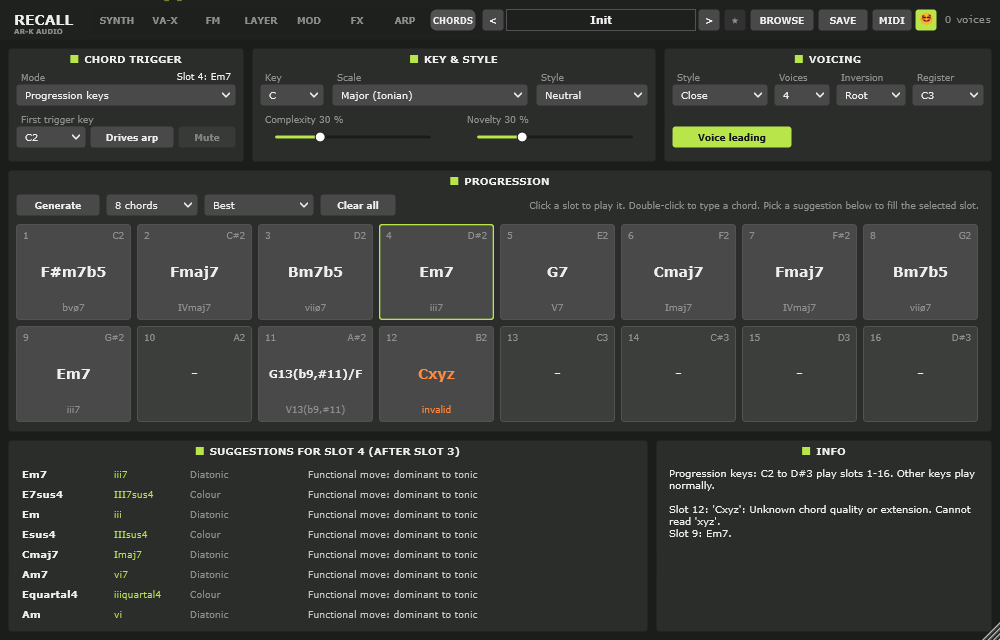
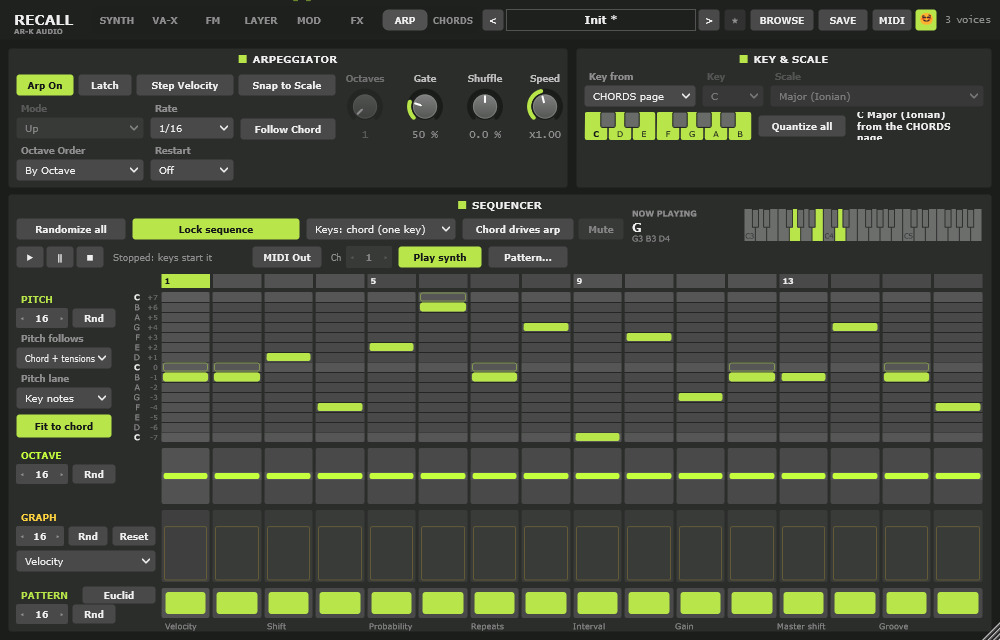
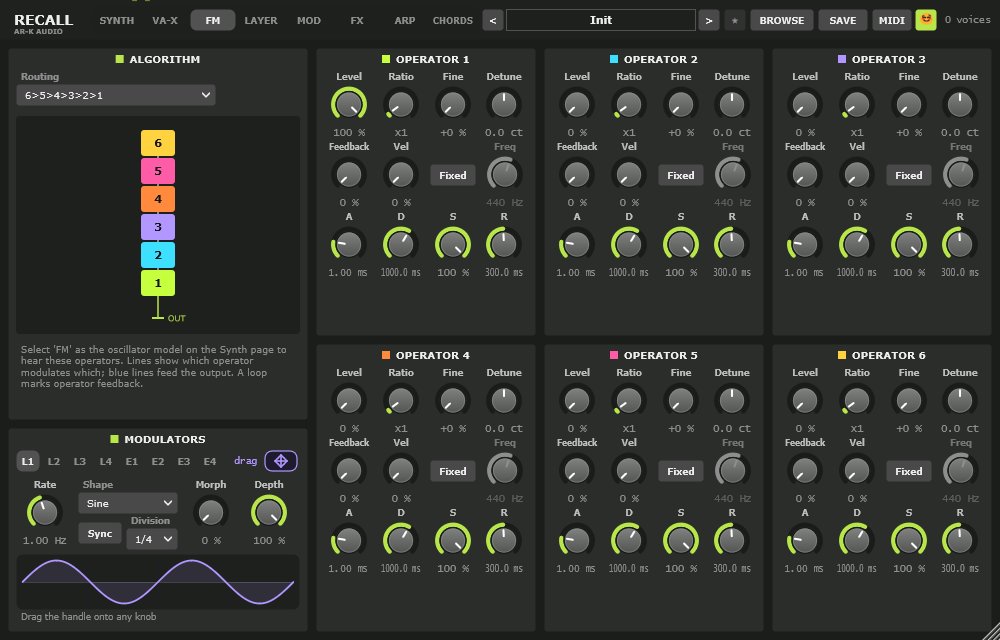
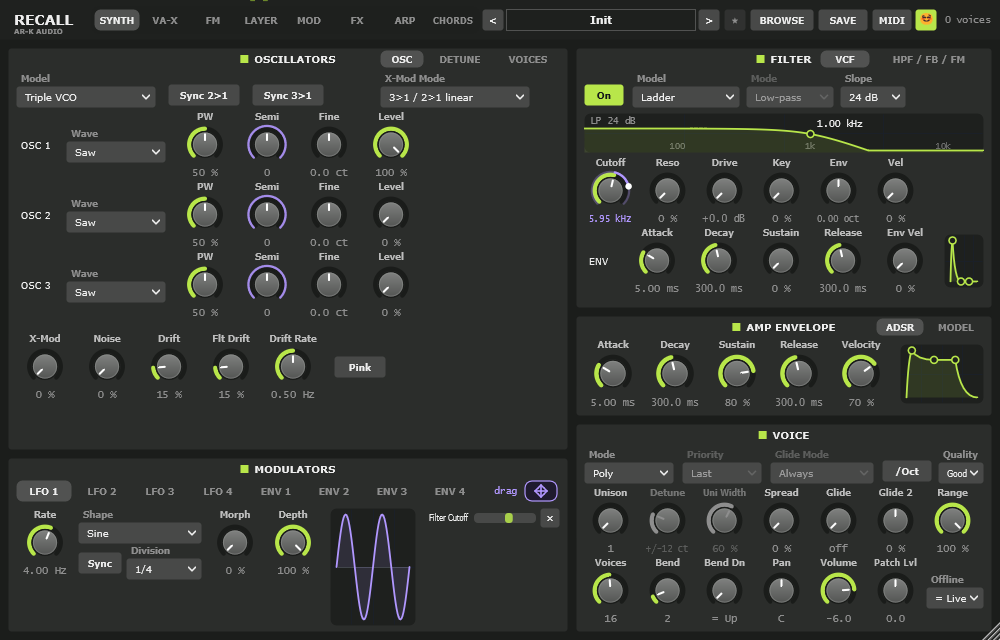
Not on sale yet. The price and the download will be in the shop.
Catch a loop and get variations back. Very musical, or completely crazy: nothing bland in between. The working name may still change.
It listens all the time. Like what just happened? Grab the loop, no recording needed.
Get a set of variations of the loop, from small musical changes to something that barely remembers where it came from.
Tiny pieces of your loop, played in key, and played by the rest of the family through ARK Link.
The Resampler is being planned now. What's on this page is the idea, not a list of finished features.
VST3 plugins for Windows, made for Ableton Live. Every plugin works on its own, and plays together with the others through ARK Link.
Not open yet. Prices, the checkout and the downloads are still being set up; the buttons below are placeholders.
A step filter that plays melodies in your key. 52 filter models, sequencer, lanes, a singing delay, MIDI drag-out.
Random melodies and rhythms you can steer, with a Déjà Vu memory. Always in key. Sends its notes to the whole family.
A polyphonic synth with chords, an arpeggiator and a step sequencer built in. Analog, FM and layered sounds, 300 presets.
Every AR-K plugin together, so they can play together from the first minute. Whether the bundle includes plugins that come later is still to decide.
Catch a loop and get variations back, musical or crazy. Being planned now.
A safe checkout from a payment service. It handles the card payment, the receipt and the VAT for your country.
You get an email with the installer and your licence.
Install, open Live, and the plugin appears under AR-K AUDIO. Add another AR-K plugin and they find each other.
Windows (64-bit) and a host that loads VST3 plugins. AR-K plugins are made and tested in Ableton Live first.
Not now: the plugins are Windows-only for the moment.
No. Every plugin works on its own. ARK Link starts to matter when you have two or more: they share their key, notes and rhythm without any routing.
To be decided with the licence system.
The refund policy will be written here before the shop opens.
AR-K AUDIO makes plugins that stay in key and play together, built on one shared core and tested in Ableton Live.
The hyphen in AR-K is Orbit, arms up, like on a fairground ride. He thought the gap was a stage.